
Yes, two food posts in a row! This is not intentional, just a function of what happens to be on my mind today. If I had gotten the chance to write yesterday, you would be reading a post about sleep, and if it had been a few weeks ago, it would be a post about childcare and/or me going back to work soon. But Gus is down for a rare morning nap, and I am seizing the opportunity to write a long overdue blog post.
Six weeks in, I am loving BLW and we are all having so much fun with it! Gus loves to try new food, and I’ve noticed that anytime I present him with a few options, he always grabs at the new food first. So far, he pretty much has enjoyed everything, with yogurt (plain yogurt with home made blueberry sauce mixed in) being the only thing that he seemed ho hum about. I still feel self conscious from time to time that we are doing something that is strange or different to a lot of people, but the more I hear of the challenges that other people are having with the traditional approach to introducing solids, the more I feel that this has definitely been the right approach for us. Now, I realize that BLW is not for everyone. The two situations that come to mind are babies with weight concerns (too small), and very large babies with voracious appetites. In both these cases, a benefit of introducing solids is that the babies can consume a lot more calories than they would get from breastmilk or formula alone, and BLW just will not deliver the caloric punch that the traditional method will. But for most situations, I really think that BLW is the superior method. I’ll get off my soapbox now, and get back to what we have been doing.
New Foods for the Whole Family
As I mentioned in my last post, one way that we are having some fun with solids, is that every week I buy one fruit and one vegetable that I would not normally buy in an effort to expand our horizons, and continue to introduce Gus to new foods. Here is a list of what we’ve hit so far:
Papaya and eggplant – The papaya was pretty easy – all three of us enjoyed it sliced. I kept the skin on Gus’ slices, so that it would be easier for him to grab. For the eggplant, I did an “eggplant french fry” recipe. My husband is not a big fan of eggplant, and I thought the recipe would be a different way to enjoy eggplant, plus if it worked out I thought that it would be a fun way for Gus to enjoy eggplant when he’s older. My husband and I got the full eggplant fry recipe (strips soaked in Italian salad dressing and rolled with egg, parmesan and breadcrumbs, then roasted in the oven). However, when it came to Gus’ portion, I chickened out about introducing wheat, eggs and dairy all in one go, so I just soaked his pieces in the salad dressing, and softened them in the microwave. Gus enjoyed his eggplant very much, but the eggplant french fry recipe was a disappointment.
Mango and broccoli – I served the mango like the papaya: sliced, with skin on for Gus, and skin off for the adults. For the broccoli, I made a stir fry with garlic slices and sesame oil for the adults, and steamed it in the microwave for Gus (as I wanted his broccoli to be softer than ours). This was a success all around.
Kiwi and green beans – For the kiwi, same treatment as the mango and papaya. The green beans were super easy. Our grocery store sells them in a plastic bag, with the ends already cut off. All you have to do is pierce the bag a few times, and steam the beans in the microwave for a few minutes. I then tossed our beans with some butter, and salt and pepper, and served them to Gus plain (and again, steamed a little longer than for the adults).
Tamarillo and butternut squash – Tama who? I discovered tamarillos in the exotic fruits section, after having already picked through the usual suspects of mango, papaya and kiwi. They look similar to roma tomatoes, though are more purpley/orange, and aren’t quite as soft. I figured I could serve them in wedges. After getting home, I did some research, and realized that tamarillos are not usually served raw since they are too bitter, but rather baked, steamed or poached in some fashion. I decided to bake them with sugar and vanilla, but was less than pleased with the result (I think I added too much vanilla extract), and in the end never ended up serving them to Gus. The butternut squash, however was a success! I found a recipe for a butternut squash and apple puree which sounded delicious. In addition to the squash and apple, it called for cumin, some vegetable stock, olive oil and salt and pepper. I did not add salt, and replaced the vegetable stock with extra olive oil (also to avoid salt) to make the dish more baby friendly, but even with these changes it was delicious!
This is a good opportunity for a sidebar about purees. While the divide between the traditional approach to introducing solids and BLW is often framed as pureed food vs. non-pureed food, there is certainly room for purees in BLW. One significant benefit of BLW is that it introduces babies to a variety of textures early on, and as one of the food websites that I follow pointed out, puree is also a texture. My rule is that if a dish would be served puree style to adults, it’s an option for us (with any baby friendly modifications required). So, this squash recipe, and my mother in law’s carrot turnip puree were perfect. Where I do have an issue with purees is with some of the commercial baby purees that throw together a strange combination of fruits and vegetables that we non-babies would never enjoy in combination.
As to serving the purees, I pre-load spoons for Gus, and as eats them, I load more on until he is done.
Cantaloupe and beets – Cantaloupe (see mango, papaya and kiwi above). I like beets, and they are actually a significant staple in my Eastern European heritage’s cuisine. But, I have always been scared of cooking with them myself, due to the mess, and also because they seemed so hard to get at. The recipe I chose was a beet salad with feta, dill, parsley and a dijon and red wine vinegar salad dressing. The beets were roasted in the oven first (skins on, tops chopped off, and wrapped in foil), and when they came out, the skins came off very easily. I made sure to wipe any beet juice quickly, and was happy to find that even though it was a very intense colour, it didn’t really stain quickly and was easy to clean off. My husband and I enjoyed the salad in its full glory, and Gus got beet wedges on their own.
Passionfruit and cauliflower – While I have tried many passionfruit flavoured foods, I have never tried passionfruit in its natural glory. Passionfruit is purple on the outside, and has an orangey pulp filled with small black seeds inside. The pulp is very sweet when the fruit is ripe, but the seeds are a bit bitter. After I sliced the passionfruit open, I hemmed and hawed about whether to give it to Gus, as I was worried about the seeds. I read some stuff online about serving passionfruit to babies, and even came across a recipe for passionfruit puree which called for pushing the passionfruit through a sieve to remove the seeds. I tried this, and managed to get a tiny bit of sweet pulp without any seeds to it. There was so little of it, and it was so slippery that I ended up serving it to Gus on my finger. Passionfruit gets wrinkled looking as it ripens, and is actually tastiest when it looks quite wrinkly and gross, and this morning I served Gus the pulp (including seeds) or our remaining wrinkly, sad looking passionfruit. This time, I pre loaded spoons for him, and while a lot of it slipped off, he quite enjoyed the bits that he managed to eat.
I have to admit that I am not a big fan of cauliflower, so I was looking for a different, innovative cauliflower recipe. While cauliflower with cheese sauce was tempting, I was hoping for something healthier, and came across for a recipe for cauliflower roasted with dijon mustard and garlic slices. The recipe also included small slices of bacon, but while that sounded delicious, I omitted it due to the salt content. Overall, the recipe turned out well! It was still cauliflower, but definitely something I would try again. I don’t think I ended up actually giving any of it to Gus though, as the cauliflower always seemed a bit too hard for my liking no matter how many times I microwaved it, and there were always lots of other foods around for him to try. I had previously served him some cauliflower and apple puree soup in a restaurant though, which made it easier to skip this time around.
With each “new” food that we’ve been buying, I have tried to introduce it (or a variation) again within a few weeks, so I get more comfortable with cooking with it and it does not fall off my radar. For squash, I have now also bought and cooked buttercup squash (wedges roasted with maple syrup and balsamic vinegar), and acorn squash (quarters roasted with butter and brown sugar), and this week I bought some yellow beets to try some of the other beet recipes I dug up on beet week. I have also bought broccolini a few times now, as a friendlier alternative to broccoli.
I meant to touch on other aspects of BLW in this post, but seeing as it’s so long already, I’ll save those thoughts for another day, and finish off with some pictures of Gus enjoying his food.
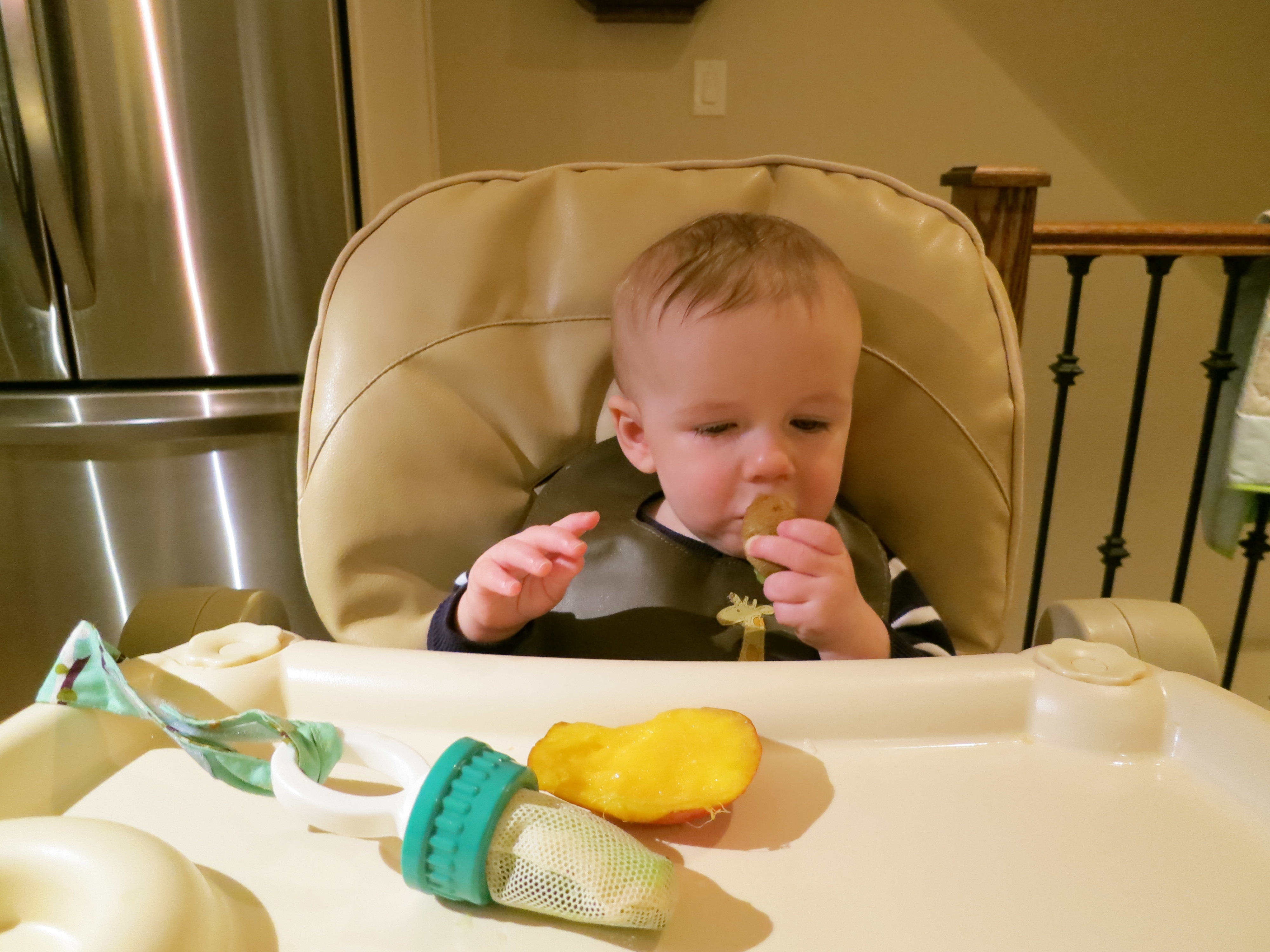
Gus enjoying some kiwi and mango (and cucumber in his mesh bag).
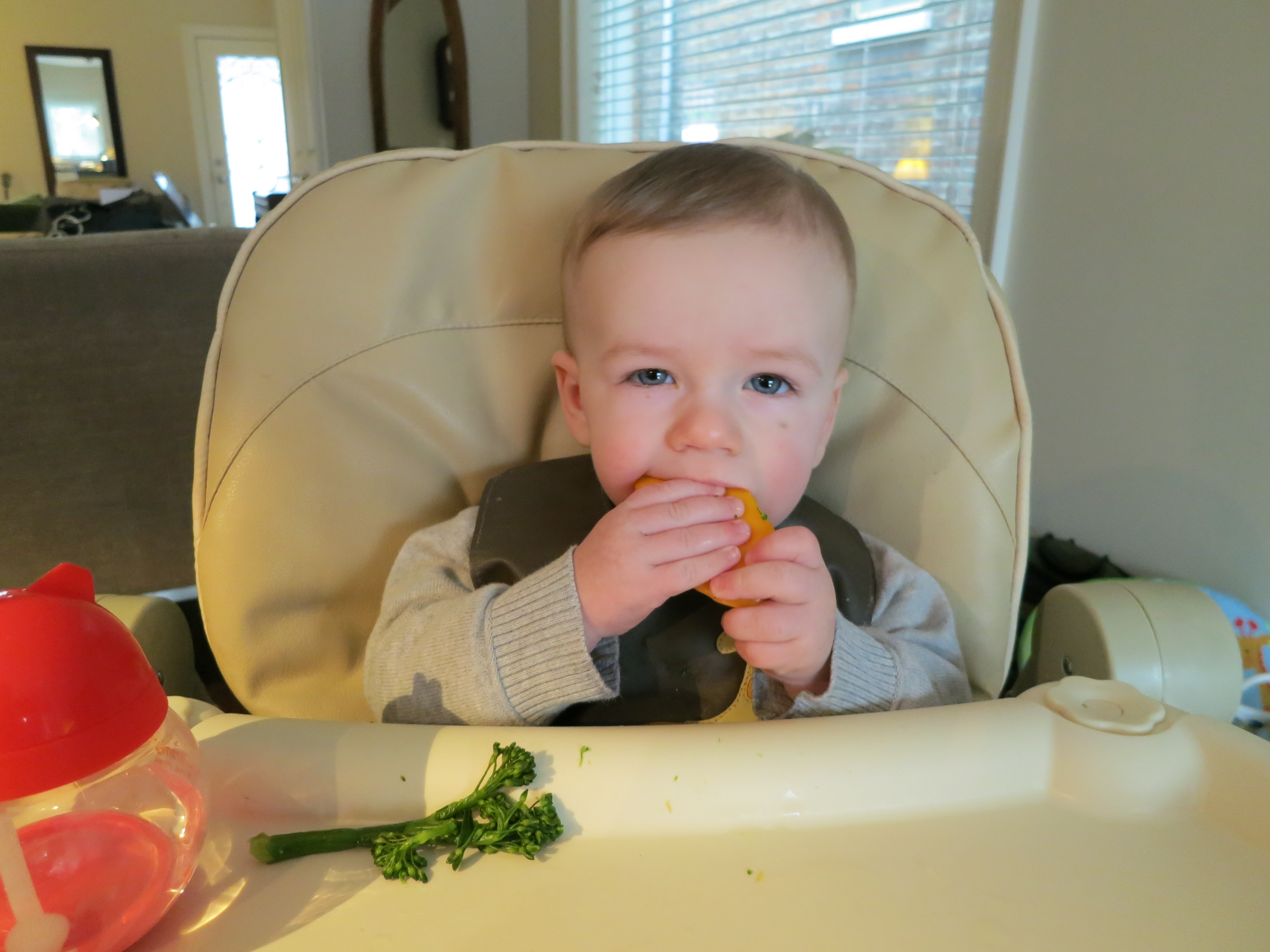
The mango shot!
 Frosty Momma