You are Getting Very Sleepy….Part 2 (The Slow Slide and the Quick Fix)

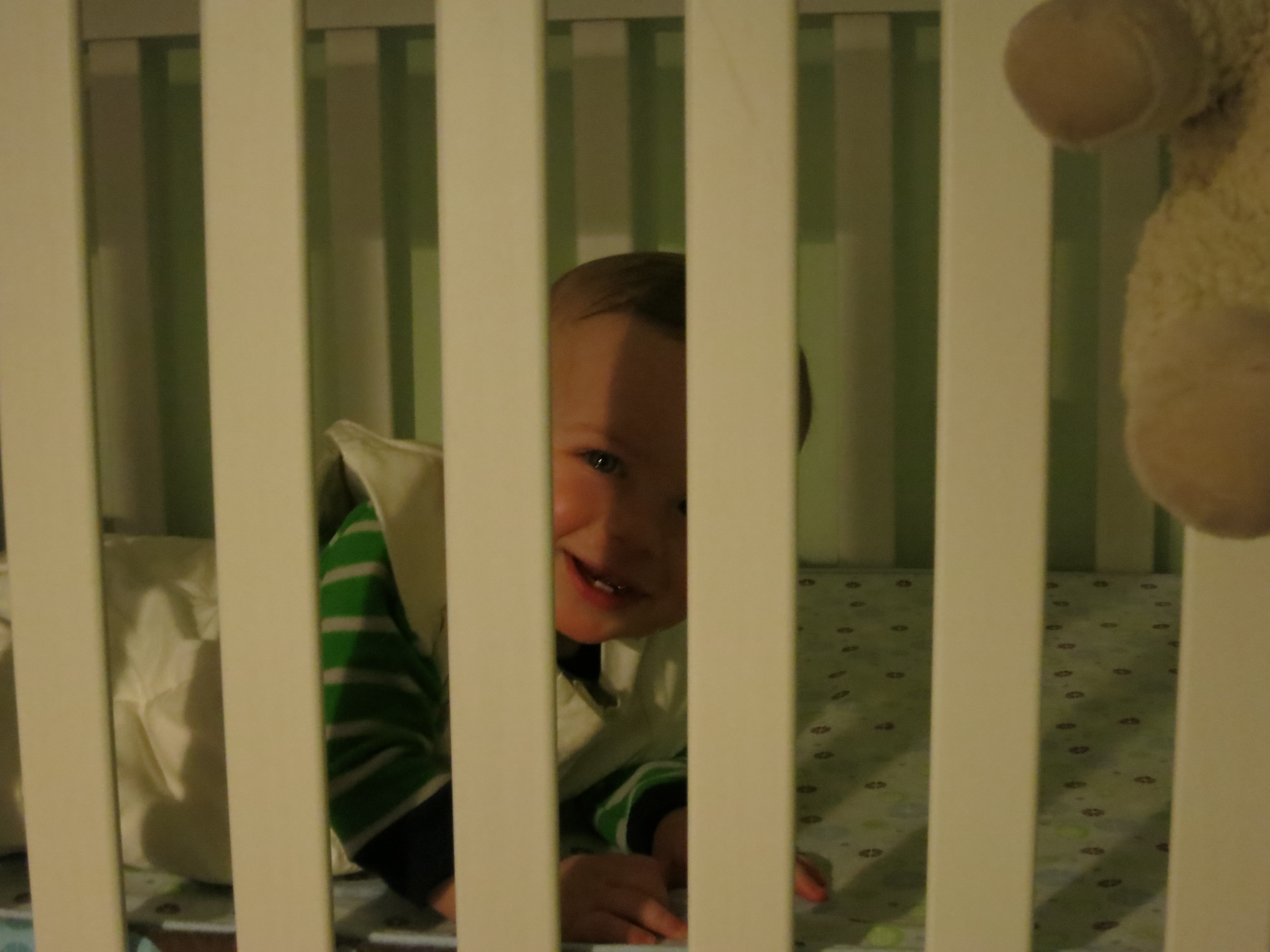
Gus getting ready for his first night sleeping in his own room!

Gus getting ready for his first night sleeping in his own room!

This post continues where the last one left off…

The Typical Sleep Pattern

As I mentioned in my last post, despite our best efforts, we eventually found ourselves with a sleep problem on our hands. Gus was a great sleeper at night from the beginning (naps are more complicated, and I will save that for another post). When I say great sleeper, what I mean is that within a few weeks of birth, he settled into one of two sleep patterns: either sleeping for ten hours straight; or sleeping for eight hours, waking up for a feed, and then going back down for another hour or two. I realize that this type of pattern early on is very unusual, which is why I attribute this to his being predisposed to being a good sleeper, rather than to anything that we did (or did not do).

Another thing I should mention is that Gus has slept in his crib from day 1 (for the first two months or so, he did do naps in his bassinet, but always slept in his crib at night).  While he has always slept in his crib, we had his crib in our room, based on the recommendations for safe sleep that we received, which recommended that babies should sleep in a crib (typically better air circulation than a bassinet) in their parents’ room until they are six months old.

Sleep Regression?

Early on, when people would ask how Gus was sleeping and we would answer honestly, they would usually be surprised, but then would be quick to point out that it probably wouldn’t last. I had read about sleep regressions, however Gus’ sleep pattern stayed pretty consistent as he got older. Around four months, (which is a typical sleep regression milestone), it did become harder for him to fall asleep initially, and there were nights where he would fuss and even cry before falling asleep (for a while, this even became the norm), however his overall sleep pattern remained the same (down for bed around 8PM, then awake at either 4AM or 6AM to eat).

The Slow Slide

Just before Gus turned six months old, we made a small change in our sleeping routine, since I figured out how to breastfeed lying down in bed. Now, instead of offering Gus a bottle for his 4AM or 6AM feeds, I would breastfeed him. This was relaxing, enjoyable and let me stay in bed longer. A few times when Gus woke up an extra time in the middle of the night, I breastfed him then too, since it was so easy now. I soon decided however that this wasn’t a good idea, as despite our best intentions I was sliding into breaking rule #2a, so I made the decision that for any wake-ups before 4AM, Gus would get a bottle, and any wake-ups after 4AM, we would breastfeed.

Despite my continued focus on sleep, around 6.5 months Gus started to regularly also wake up around midnight. This wake-up often coincided with when I was going to bed. Since he was still sleeping in our room, I suspected that me having the light on to read, and the general noise I was making was causing him to wake up and stay awake. My suspicions were confirmed one night when my husband and I were up later than usual, and we heard Gus wake up. However, just as I was ready to go up to calm him down, Gus got quiet and went back to sleep on his own (when he woke up with us in the room, even though we would try to soothe him by just talking or singing to him, we would invariably need to pick him up and feed him before he calmed down enough to sleep). I knew that it was time to move Gus into his own room, however I resisted as long as I could as I enjoyed having him in our room so much.

By now, we were no longer enjoying the ten hour sleep patterns, and were lucky if we got only the 4AM wake up. The midnight wake ups were pretty consistent, and sometimes there would even be another wake up. One night I realized that Gus was starting to eat less at his 4AM feed, and it dawned on me that I was now doing exactly what I had worked so hard not to do: I was feeding Gus when he woke up in the middle of the night not because he was hungry, but to soothe him to go back to sleep, which then meant he was not as hungry at his “normal” feeding time.

The next night, I ran a test. I gave Gus a bottle with half the milk I normally would at his midnight feeding, and sure enough he settled down to sleep just fine after that, and breastfed for 30 minutes instead of 2o minutes when he woke up at 4AM. The following night, when Gus woke up at midnight, I once again gave him a half-bottle, however this time he was still fussing when he was done. This was a rare night when my husband also happened to wake up, and he insisted that Gus must still be hungry since I’d given him such a small bottle (this is a constant battle between us – my husband thinks Gus is hungry at any sign of discomfort, while I take into account when/what he last ate and consider what else could be wrong). I insisted that Gus didn’t need any more, but since he was still crying, I started to doubt myself and asked my husband to go get the bottle of breastmilk we had in the fridge.

In the time it took my husband to come back, Gus had almost calmed down, and I ended up giving him only a few sips of the bottle before he settled down completely and fell back asleep. The sleep was short lived, as he woke up crying at 2AM (I managed to talk him back to sleep that time), and then again at 4AM and 6AM. This  was our worst night of sleep since Gus was about two weeks old, and after that I decided that it was time to finally move Gus to his room.

Since Gus was also teething and getting over a cold, I expected that moving him to his own room would help the sleep situation, but not completely solve it.  I also expected that Gus would take longer to settle down since he’d be sleeping in a different room than he was used to.

The Quick Fix

On our chosen night, we set up the crib in Gus’ room, and got him ready for bed as we normally do. We put him down in his crib, left the room, and within minutes he was asleep. I couldn’t believe how easy it was! That night he slept through until 4AM. The following night, he went to sleep with no problems again, and slept through until 5AM. The next two nights he again went to sleep easily, but this time he woke up at 6:20AM both times. And just like that, our good sleeper was back!

You Are Getting Very Sleepy…Part 1 (the Rules)

So far on this blog, I have been pretty quiet on the topic of sleep, which may seem like a glaring omission for a brand new  parent, given that sleep is probably the number one topic that people discuss when it comes to babies. The main reason for this omission is that Gus has been a very good sleeper, which I attribute partly to his innate nature (i.e. he’s programmed to be a good sleeper), and partly to our efforts from the beginning not to get in his way and mess up his ability to sleep well. However, baby sleep is a tricky thing, subject to regressions and changing habits, and even despite our best efforts, we recently found ourselves with a sleep problem on our hands.

Before Gus was born, my husband and I heard all the horror stories about how our sleep was going to be disrupted once the baby came. This was annoying enough early on in pregnancy, but got increasingly annoying as pregnancy progressed and my sleep got worse and worse. By the third trimester, I was getting up almost constantly to pee, and when I wasn’t, I was waking up uncomfortable due to aches and pains of late pregnancy and the inability to find a comfortable position to sleep in. So hearing that I should “enjoy my sleep while I can” was the last thing I wanted to hear!

While everyone was quick to tell us how tough sleep was going to be, I don’t think anyone had any helpful tips for how to avoid/minimize the pain. However, despite this, we were lucky to go into parenthood armed with what I consider to be two very helpful rules:

Rule #1 – Don’t set your baby down already asleep, but rather put them in their crib/bassinet sleepy but awake.

This is one of those things that while not intuitive (i.e. left to my own devices, I would have done the complete opposite), actually makes a lot of sense, and is probably the most helpful thing we learned in our very informative babycare class. The basic premise is that babies will wake up several times a night as they move from one sleep cycle to the next, and if they wake up somewhere that they don’t remember falling asleep, they will become disoriented and distressed and will have difficulty putting themselves back to sleep.  However, if the baby wakes up in a familiar place, it will be much easier for them to put themselves back to sleep, often without the parents even knowing that their baby had woken up.

While this sounded so logical, I was worried that it would be impossible to implement in practice. On our first night home with Gus (technically his third real night) when it came time for him to go to bed, we swaddled him tightly like we were taught at the hospital, and placed him in his crib on his back. He smiled a tired smile at us, we turned off the lights and left the room. And…that was it. He was asleep within minutes. I couldn’t believe how easy it was! We did the same thing the next night, and the next night, and the night after that, and each time it was just as easy as the first night. Gus is now 8 months old, and I think I can count on one hand the number of times we’ve put him in his bed already asleep. The nice thing about having this rule in place, is that the few times where Gus was overtired and in full meltdown mode, we had the option of choosing to break it and using the standard parent bag of tricks to get him to fall asleep before being put in his crib (contrast this with with parents who already use all the tricks on a nightly basis, and then when they really need them, there is nothing left).

This brings me to our other rule.

Rule #2 – Don’t (breast)feed your baby right before they sleep.

Like rule #1, left to my own devices, I would have done the exact opposite (in fact, I remember when Gus was very young how many people would say “time for a nap” as soon as I finished feeding him). However,  since Gus was born 13 days late, I had some extra time in late pregnancy to read a few parenting books. One book I read stressed the importance of separating the eating and sleeping portion of your baby’s routine with some activity (e.g. a walk, a bath, some play time), so that your baby does not associate feeding with sleep (and therefore need to be fed in order to fall asleep). This is particularly important with breastfeeding, which in addition to providing food, is such a relaxing and comforting activity, but I also applied it to bottle feeding.

Where necessary, we broke rule #2 from time to time (more often than we broke rule #1), however we were always mindful that we were doing something we shouldn’t and very careful not to do it too often/too many times in a row so that it would not develop into a bad habit.

Once Gus was born, we stumbled on another practice, which I think further helped him sleep well at night. I’ll call this rule #2a:

Rule #2a – Only bottle feed for middle of the night wake ups.

Due to initial challenges with breastfeeding, we introduced the bottle very early on, and decided that any middle of the night feedings would be bottle feedings. Our main rationale for bottles at night was so that my husband and I could share in the night feedings (however as it turned out, my husband only ended up doing a handful of them since I was always the one who woke up, while he managed to stay asleep!). A secondary rationale was that since breastfeeding was proving to be difficult to figure out (and taking a very long time), we would save it for the day time when everyone was functioning at their best and had the patience/time to figure it out.

While our reasons for bottle feeding at night did not have anything to do with ensuring that Gus slept well, I suspect that this practice did exactly that. Our feedings at night were purely a business transaction: Gus would get his bottle; I’d change his diaper; and then put him back to bed. This is very different than the soothing, cuddly practice of breastfeeding. At my baby and me fitness classes, sleep is a popular topic of discussion, and I hear of many women who get into a pattern of breastfeeding their baby every time they wake up, only to find that their baby is waking up more and more, and eating less and less each time, but needing the comfort of the breast to fall back asleep.

I should mention that when I refer to bottle feeding, I’m not necessarily speaking about formula (I only point this out, since many people suggest that formula fed babies sleep better – I personally have not found a noticeable difference between formula and breastmilk). We do supplement with formula, but Gus primarily receives breastmilk (whether via boob or bottle), and our night time bottles have been almost exclusively breastmilk.

Overall, these rules have served us well. However, even with the attention that we have paid to ensuring Gus sleeps well, and being blessed with a baby predisposed to sleeping well, we still found ourselves with a problem on our hands, which I will elaborate on in my next post.