Baby Led Weaning – Weeks 7 to 10

As I mentioned previously, one way that we are having fun with solids, is that every week I buy one fruit and one vegetable that I would not normally buy in an effort to expand our horizons, and continue to introduce Baby Boy to new foods. I have had some challenges in introducing food groups other than fruits and vegetables, which I will write about in other posts.  Here, however are our latest fruit and vegetable successes:

Plums and collard greens – Plums were straightforward – I just cut them into wedges, and Gus ate away. Many of our vegetables of the week so far have been root vegetables, because for some reason I typically stay away from them in the grocery store. I’m more of a leafy greens person, so leafy greens are usually well represented in our diet. However, while we eat chard and spinach by the bucket (not to mention all types of salad leaves), I only remember ever buying collard greens once or twice before. This time around, I made the collard greens by sauteing them with olive oil, chopped onion and garlic, some chili flakes, a pinch of sugar and some sesame oil.

I thought they turned out quite well. The texture is definitely tougher – more like seaweed than other greens I’m used to. My husband, however didn’t like how oily they tasted  since we usually steam/boil our greens (though every collard greens recipe I found included some kind of oil). Gus, as always enjoyed the new food.

Golden melon and parsnips – Golden melon is similar to honeydew, and I served it the way I always serve melon to Gus – cut into cubes/small wedges, with the skin left on so it is easier to grip. Melons have been a big hit, and golden melon was no different. The parsnips turned out to be a hit for the whole family, so much so that I have since bought them several more times and incorporated them into our regular meal rotation.

The recipe I used for parsnips is very straightforward: peel the parsnips, slice into wedges/fingers and toss with oil and herbs, then bake at 450 for 20 minutes (or even longer, until they brown nicely). We lived in upstate New York for a year, where we bought our groceries at Wegman’s and fell in love with quite a few of the Wegman’s (aka Weggers) store brand items. Probably my favourite is the Wegman’s basting oil, which is a grapeseed oil with some herbs and spices mixed in. It’s great for meats, fish, and of course roasted vegetables. So this is what I used on the parsnips, and they turned out delish! If you leave them in the oven a bit longer, the sugars come out and they become almost caramelized. My husband couldn’t believe how good they tasted without me adding all sorts of crazy unhealthy ingredients to them. In case you’re wondering, Gus enjoyed them too.

Red bananas and rutabaga – this particular week I had a tough time picking a fruit. My friend had recommended starfruit, however the only starfruit left in the store was pretty sad looking. The red bananas were tiny little bananas, and based on the description in the store were supposed to taste quite sweet when eaten like a normal banana. The first time I tried the banana however, it was quite woody tasting. I soon realized that there is a reason that they are called red bananas – when they look black or brown they are not yet ripe and don’t taste good at all (this is the complete opposite of “normal bananas”). However, when the skin turned bright red, the banana inside was wonderfully sweet, but the taste was not as cloying as a ripe, sweet “normal” banana would be (the banana also stayed firm, unlike a ripe normal banana). Gus is a big fan of bananas, so he happily gobbled the red bananas.

I continued our trend of buying root vegetables with a rutabaga. Rutabaga looks like a giant turnip, and has a similar taste and texture. After reviewing a few rutabaga recipes, I chose one for rutabaga fries – cut the rutabaga into spears, toss with olive oil and minced garlic and herbs. If I remember correctly, I tossed them with some paprika too. This turned out well, and was a hit all around.

Pumello (Pomelo) and turnip – Pumello is a citrus fruit that looks like a giant grapefruit (and is about the size of a small melon). I was planning on doing something fun with it, but I wanted to serve it dessert style, and I kept finding recipes for pumello mains and salads. In the end, I just served it in slices. The pumello was pink on the inside, and had a very thick pith. The pith is apparently quite bitter, so you want to make sure you clear it all away from the flesh before you serve it. The taste was similar to grapefruit, but sweeter, and Gus seemed to enjoy it quite a bit. As a general comment, I should mention that citrus is one of the types of food that can be allergenic/harder on the digestive system, so if you are just starting out, it should probably not be among the first foods introduced.

Our (root) vegetable of the week was turnip. I’ve been roasting a lot of my vegetables, so was looking for something other than a roasted (or mashed) turnip recipe. I found one for caramelized turnips, which sounded pretty awesome, but I don’t think really turned out for me. The recipe calls for cubed turnip to be sautéed with some water and a chicken bouillon cube (I skipped the bullion cube, though I may have added some low sodium vegetable broth – I can’t remember now) for 15 minutes or until the water evaporates. Then you stir in some butter and sugar, and after cooking for another 10 minutes the turnips are supposed to get brown and sticky. Mine never did get brown and sticky; they just got really soft, so I was pretty disappointed with how the recipe turned out. But, it was good enough for Gus and we were able to cross another vegetable off our list. I think I will give this recipe another try in the future, as  it sounded so yummy and I suspect I screwed it up somehow.

That’s it for now!

Working 9 to 5…(Part 1 – the Background)

My latest favourite picture of Gus. It was taken the day before I started work and is currently the desktop background on my computers.

My latest favourite picture of Gus. It was taken the day before I started work and is currently the desktop background on my computers.

Last week, I went back to work. While everything went as smoothly as can be expected, I am still processing the change from full-time mom to full-time employee, and feeling a bit worn down by the whole thing. I feel blessed to have had the opportunity to stay home with Gus for 8.5 months, as I know that many working moms in other countries (especially in the U.S, but even in many European countries) have much shorter maternity leaves. However, in a Canadian context where many, if not most women take a full year I do feel like I am missing out by going back early.

How ‘Bout that Year of Maternity Leave, Eh?

While we’re on the topic, I may as well explain how the year of maternity leave thing works for those who are unfamiliar with the process. In a nutshell, the government has a program where mothers (who have given birth) are entitled to up to 15 weeks of maternity leave, and parents (mother or father or both combined) are entitled to a further 35 weeks of parental leave (i.e. both parents can take parental leave, but they have to share the benefit). Before you are entitled to claim benefits, you have a 2 week waiting period where you are not paid, which adds up to 52 weeks, and voila there you have it! Assuming you have 600 hours of “insurable earnings” (this is roughly four months of full time work) in the last 52 weeks, you are entitled to the benefit. Something that most people don’t know (sadly, even people who can benefit from it), is that about three years ago, the government introduced a program where even self employed people can receive maternity and parental leave benefits.

The benefit you are entitled to depends on your average weekly earnings over the last 52 weeks – you are entitled to 55% of earnings up to an earnings ceiling of $47,400 (so 55% of 47,400). I was entitled to the maximum benefit and after deductions for tax, I ended up with $1,700 per month in my pocket. Some employers have “top-up” programs where they will top-up what the government pays you to 75% or more of your actual salary, though I believe this is often just for the maternity leave portion of the benefit.

So Why Go Back Early?

There are many reasons why some women go back early – many couples share the parental portion of the benefit, so dad gets to stay home for a few months, other people find their finances too tight to afford a full year, while other women are at a point in their career (or on a certain career track) where being away from work for a year is not a viable option. In my case, unfortunately it’s a career thing. When we first started trying to have a baby, we thought we had all our ducks lined up in a row, and that we would start a family at a point in our life where it worked for us on all levels (emotional, financial, career wise, relationship wise, etc).

Unfortunately, with the whole process taking about 3 years longer than expected, we were in a different place (figuratively and literally – having moved across the country two months before conceiving!) than we’d expected. Before we moved, I felt fortunate to have found what I thought would be a dream job back in Toronto. Unfortunately, it turned out not to be the case, and I quit after about four months, or just after the end of my first trimester. I ended up taking a contract position with a place I used to work years ago, which took me right through to my maternity leave. After the super stressful situation at my previous job, the contract was a dream, however it was a lower level position that what I am qualified for. A low stress job with no responsibility was perfect while pregnant, but it’s not the type of work I want to be doing long term, so I knew that I would have to look for new work after maternity leave.

While I really wanted to take the full year of leave, this would mean that I would be looking for a new job after being out of my field for a year and a half (and actually closer to two years, since I am not putting the failed job where I worked for four months on my resume). This made me really nervous, so before going on leave, I decided that I would start looking for work when Gus was 9 months old, which meant that I was mentally prepared to go back at that point.

In an interesting twist, before I went on maternity leave, I found out that the company where I was doing the contract would soon be looking for a short term replacement for someone going on maternity leave, but in the department which was actually more suited to my skill set than the department I’d been working in. The timing didn’t line up perfectly, but long story short(er), I’m back on contract now, doing a combination role of low level, necessary work for the department I was with last year, and higher level, interesting, looks-good-on-my-resume work for the other department. This should tide me over until the fall, at which point it will be time to make a further move. I have about five more posts worth of thoughts on the whole work thing, but I’ll leave them for another time.

The actual point of this post was to describe our new routine a bit..what has changed and what has stayed the same since I’ve gone back. As my word count is already up, I’ll leave that for part 2.


You are Getting Very Sleepy….Part 2 (The Slow Slide and the Quick Fix)

Gus getting ready for his first night sleeping in his own room!

Gus getting ready for his first night sleeping in his own room!

This post continues where the last one left off…

The Typical Sleep Pattern

As I mentioned in my last post, despite our best efforts, we eventually found ourselves with a sleep problem on our hands. Gus was a great sleeper at night from the beginning (naps are more complicated, and I will save that for another post). When I say great sleeper, what I mean is that within a few weeks of birth, he settled into one of two sleep patterns: either sleeping for ten hours straight; or sleeping for eight hours, waking up for a feed, and then going back down for another hour or two. I realize that this type of pattern early on is very unusual, which is why I attribute this to his being predisposed to being a good sleeper, rather than to anything that we did (or did not do).

Another thing I should mention is that Gus has slept in his crib from day 1 (for the first two months or so, he did do naps in his bassinet, but always slept in his crib at night).  While he has always slept in his crib, we had his crib in our room, based on the recommendations for safe sleep that we received, which recommended that babies should sleep in a crib (typically better air circulation than a bassinet) in their parents’ room until they are six months old.

Sleep Regression?

Early on, when people would ask how Gus was sleeping and we would answer honestly, they would usually be surprised, but then would be quick to point out that it probably wouldn’t last. I had read about sleep regressions, however Gus’ sleep pattern stayed pretty consistent as he got older. Around four months, (which is a typical sleep regression milestone), it did become harder for him to fall asleep initially, and there were nights where he would fuss and even cry before falling asleep (for a while, this even became the norm), however his overall sleep pattern remained the same (down for bed around 8PM, then awake at either 4AM or 6AM to eat).

The Slow Slide

Just before Gus turned six months old, we made a small change in our sleeping routine, since I figured out how to breastfeed lying down in bed. Now, instead of offering Gus a bottle for his 4AM or 6AM feeds, I would breastfeed him. This was relaxing, enjoyable and let me stay in bed longer. A few times when Gus woke up an extra time in the middle of the night, I breastfed him then too, since it was so easy now. I soon decided however that this wasn’t a good idea, as despite our best intentions I was sliding into breaking rule #2a, so I made the decision that for any wake-ups before 4AM, Gus would get a bottle, and any wake-ups after 4AM, we would breastfeed.

Despite my continued focus on sleep, around 6.5 months Gus started to regularly also wake up around midnight. This wake-up often coincided with when I was going to bed. Since he was still sleeping in our room, I suspected that me having the light on to read, and the general noise I was making was causing him to wake up and stay awake. My suspicions were confirmed one night when my husband and I were up later than usual, and we heard Gus wake up. However, just as I was ready to go up to calm him down, Gus got quiet and went back to sleep on his own (when he woke up with us in the room, even though we would try to soothe him by just talking or singing to him, we would invariably need to pick him up and feed him before he calmed down enough to sleep). I knew that it was time to move Gus into his own room, however I resisted as long as I could as I enjoyed having him in our room so much.

By now, we were no longer enjoying the ten hour sleep patterns, and were lucky if we got only the 4AM wake up. The midnight wake ups were pretty consistent, and sometimes there would even be another wake up. One night I realized that Gus was starting to eat less at his 4AM feed, and it dawned on me that I was now doing exactly what I had worked so hard not to do: I was feeding Gus when he woke up in the middle of the night not because he was hungry, but to soothe him to go back to sleep, which then meant he was not as hungry at his “normal” feeding time.

The next night, I ran a test. I gave Gus a bottle with half the milk I normally would at his midnight feeding, and sure enough he settled down to sleep just fine after that, and breastfed for 30 minutes instead of 2o minutes when he woke up at 4AM. The following night, when Gus woke up at midnight, I once again gave him a half-bottle, however this time he was still fussing when he was done. This was a rare night when my husband also happened to wake up, and he insisted that Gus must still be hungry since I’d given him such a small bottle (this is a constant battle between us – my husband thinks Gus is hungry at any sign of discomfort, while I take into account when/what he last ate and consider what else could be wrong). I insisted that Gus didn’t need any more, but since he was still crying, I started to doubt myself and asked my husband to go get the bottle of breastmilk we had in the fridge.

In the time it took my husband to come back, Gus had almost calmed down, and I ended up giving him only a few sips of the bottle before he settled down completely and fell back asleep. The sleep was short lived, as he woke up crying at 2AM (I managed to talk him back to sleep that time), and then again at 4AM and 6AM. This  was our worst night of sleep since Gus was about two weeks old, and after that I decided that it was time to finally move Gus to his room.

Since Gus was also teething and getting over a cold, I expected that moving him to his own room would help the sleep situation, but not completely solve it.  I also expected that Gus would take longer to settle down since he’d be sleeping in a different room than he was used to.

The Quick Fix

On our chosen night, we set up the crib in Gus’ room, and got him ready for bed as we normally do. We put him down in his crib, left the room, and within minutes he was asleep. I couldn’t believe how easy it was! That night he slept through until 4AM. The following night, he went to sleep with no problems again, and slept through until 5AM. The next two nights he again went to sleep easily, but this time he woke up at 6:20AM both times. And just like that, our good sleeper was back!

You Are Getting Very Sleepy…Part 1 (the Rules)

So far on this blog, I have been pretty quiet on the topic of sleep, which may seem like a glaring omission for a brand new  parent, given that sleep is probably the number one topic that people discuss when it comes to babies. The main reason for this omission is that Gus has been a very good sleeper, which I attribute partly to his innate nature (i.e. he’s programmed to be a good sleeper), and partly to our efforts from the beginning not to get in his way and mess up his ability to sleep well. However, baby sleep is a tricky thing, subject to regressions and changing habits, and even despite our best efforts, we recently found ourselves with a sleep problem on our hands.

Before Gus was born, my husband and I heard all the horror stories about how our sleep was going to be disrupted once the baby came. This was annoying enough early on in pregnancy, but got increasingly annoying as pregnancy progressed and my sleep got worse and worse. By the third trimester, I was getting up almost constantly to pee, and when I wasn’t, I was waking up uncomfortable due to aches and pains of late pregnancy and the inability to find a comfortable position to sleep in. So hearing that I should “enjoy my sleep while I can” was the last thing I wanted to hear!

While everyone was quick to tell us how tough sleep was going to be, I don’t think anyone had any helpful tips for how to avoid/minimize the pain. However, despite this, we were lucky to go into parenthood armed with what I consider to be two very helpful rules:

Rule #1 – Don’t set your baby down already asleep, but rather put them in their crib/bassinet sleepy but awake.

This is one of those things that while not intuitive (i.e. left to my own devices, I would have done the complete opposite), actually makes a lot of sense, and is probably the most helpful thing we learned in our very informative babycare class. The basic premise is that babies will wake up several times a night as they move from one sleep cycle to the next, and if they wake up somewhere that they don’t remember falling asleep, they will become disoriented and distressed and will have difficulty putting themselves back to sleep.  However, if the baby wakes up in a familiar place, it will be much easier for them to put themselves back to sleep, often without the parents even knowing that their baby had woken up.

While this sounded so logical, I was worried that it would be impossible to implement in practice. On our first night home with Gus (technically his third real night) when it came time for him to go to bed, we swaddled him tightly like we were taught at the hospital, and placed him in his crib on his back. He smiled a tired smile at us, we turned off the lights and left the room. And…that was it. He was asleep within minutes. I couldn’t believe how easy it was! We did the same thing the next night, and the next night, and the night after that, and each time it was just as easy as the first night. Gus is now 8 months old, and I think I can count on one hand the number of times we’ve put him in his bed already asleep. The nice thing about having this rule in place, is that the few times where Gus was overtired and in full meltdown mode, we had the option of choosing to break it and using the standard parent bag of tricks to get him to fall asleep before being put in his crib (contrast this with with parents who already use all the tricks on a nightly basis, and then when they really need them, there is nothing left).

This brings me to our other rule.

Rule #2 – Don’t (breast)feed your baby right before they sleep.

Like rule #1, left to my own devices, I would have done the exact opposite (in fact, I remember when Gus was very young how many people would say “time for a nap” as soon as I finished feeding him). However,  since Gus was born 13 days late, I had some extra time in late pregnancy to read a few parenting books. One book I read stressed the importance of separating the eating and sleeping portion of your baby’s routine with some activity (e.g. a walk, a bath, some play time), so that your baby does not associate feeding with sleep (and therefore need to be fed in order to fall asleep). This is particularly important with breastfeeding, which in addition to providing food, is such a relaxing and comforting activity, but I also applied it to bottle feeding.

Where necessary, we broke rule #2 from time to time (more often than we broke rule #1), however we were always mindful that we were doing something we shouldn’t and very careful not to do it too often/too many times in a row so that it would not develop into a bad habit.

Once Gus was born, we stumbled on another practice, which I think further helped him sleep well at night. I’ll call this rule #2a:

Rule #2a – Only bottle feed for middle of the night wake ups.

Due to initial challenges with breastfeeding, we introduced the bottle very early on, and decided that any middle of the night feedings would be bottle feedings. Our main rationale for bottles at night was so that my husband and I could share in the night feedings (however as it turned out, my husband only ended up doing a handful of them since I was always the one who woke up, while he managed to stay asleep!). A secondary rationale was that since breastfeeding was proving to be difficult to figure out (and taking a very long time), we would save it for the day time when everyone was functioning at their best and had the patience/time to figure it out.

While our reasons for bottle feeding at night did not have anything to do with ensuring that Gus slept well, I suspect that this practice did exactly that. Our feedings at night were purely a business transaction: Gus would get his bottle; I’d change his diaper; and then put him back to bed. This is very different than the soothing, cuddly practice of breastfeeding. At my baby and me fitness classes, sleep is a popular topic of discussion, and I hear of many women who get into a pattern of breastfeeding their baby every time they wake up, only to find that their baby is waking up more and more, and eating less and less each time, but needing the comfort of the breast to fall back asleep.

I should mention that when I refer to bottle feeding, I’m not necessarily speaking about formula (I only point this out, since many people suggest that formula fed babies sleep better – I personally have not found a noticeable difference between formula and breastmilk). We do supplement with formula, but Gus primarily receives breastmilk (whether via boob or bottle), and our night time bottles have been almost exclusively breastmilk.

Overall, these rules have served us well. However, even with the attention that we have paid to ensuring Gus sleeps well, and being blessed with a baby predisposed to sleeping well, we still found ourselves with a problem on our hands, which I will elaborate on in my next post.


Baby Led Weaning – 6 Weeks On

Yes, two food posts in a row! This is not intentional, just a function of what happens to be on my mind today. If I had gotten the chance to write yesterday, you would be reading a post about sleep, and if it had been a few weeks ago, it would be a post about childcare and/or me going back to work soon. But Gus is down for a rare morning nap, and I am seizing the opportunity to write a long overdue blog post.

Six weeks in, I am loving BLW and we are all having so much fun with it!  Gus loves to try new food, and I’ve noticed that anytime I present him with a few options, he always grabs at the new food first. So far, he pretty much has enjoyed everything, with yogurt (plain yogurt with home made blueberry sauce mixed in) being the only thing that he seemed ho hum about. I still feel self conscious from time to time that we are doing something that is strange or different to a lot of people, but the more I hear of the challenges that other people are having with the traditional approach to introducing solids, the more I feel that this has definitely been the right approach for us.  Now, I realize that BLW is not for everyone. The two situations that come to mind are babies with weight concerns (too small), and very large babies with voracious appetites. In both these cases, a benefit of introducing solids is that the babies can consume a lot more calories than they would get from breastmilk or formula alone, and BLW just will not deliver the caloric punch that the traditional method will.  But for most situations, I really think that BLW is the superior method. I’ll get off my soapbox now, and get back to what we have been doing.

New Foods for the Whole Family

As I mentioned in my last post, one way that we are having some fun with solids, is that every week I buy one fruit and one vegetable that I would not normally buy in an effort to expand our horizons, and continue to introduce Gus to new foods. Here is a list of what we’ve hit so far:

Papaya and eggplant – The papaya was pretty easy – all three of us enjoyed it sliced. I kept the skin on Gus’ slices, so that it would be easier for him to grab. For the eggplant, I did an “eggplant french fry” recipe. My husband is not a big fan of eggplant, and I thought the recipe would be a different way to enjoy eggplant, plus if it worked out I thought that it would be a fun way for Gus to enjoy eggplant when he’s older. My husband and I got the full eggplant fry recipe (strips soaked in Italian salad dressing and rolled with egg, parmesan and breadcrumbs, then roasted in the oven). However, when it came to Gus’ portion, I chickened out about introducing wheat, eggs and dairy all in one go, so I just soaked his pieces in the salad dressing, and softened them in the microwave. Gus enjoyed his eggplant very much, but the eggplant french fry recipe was a disappointment.

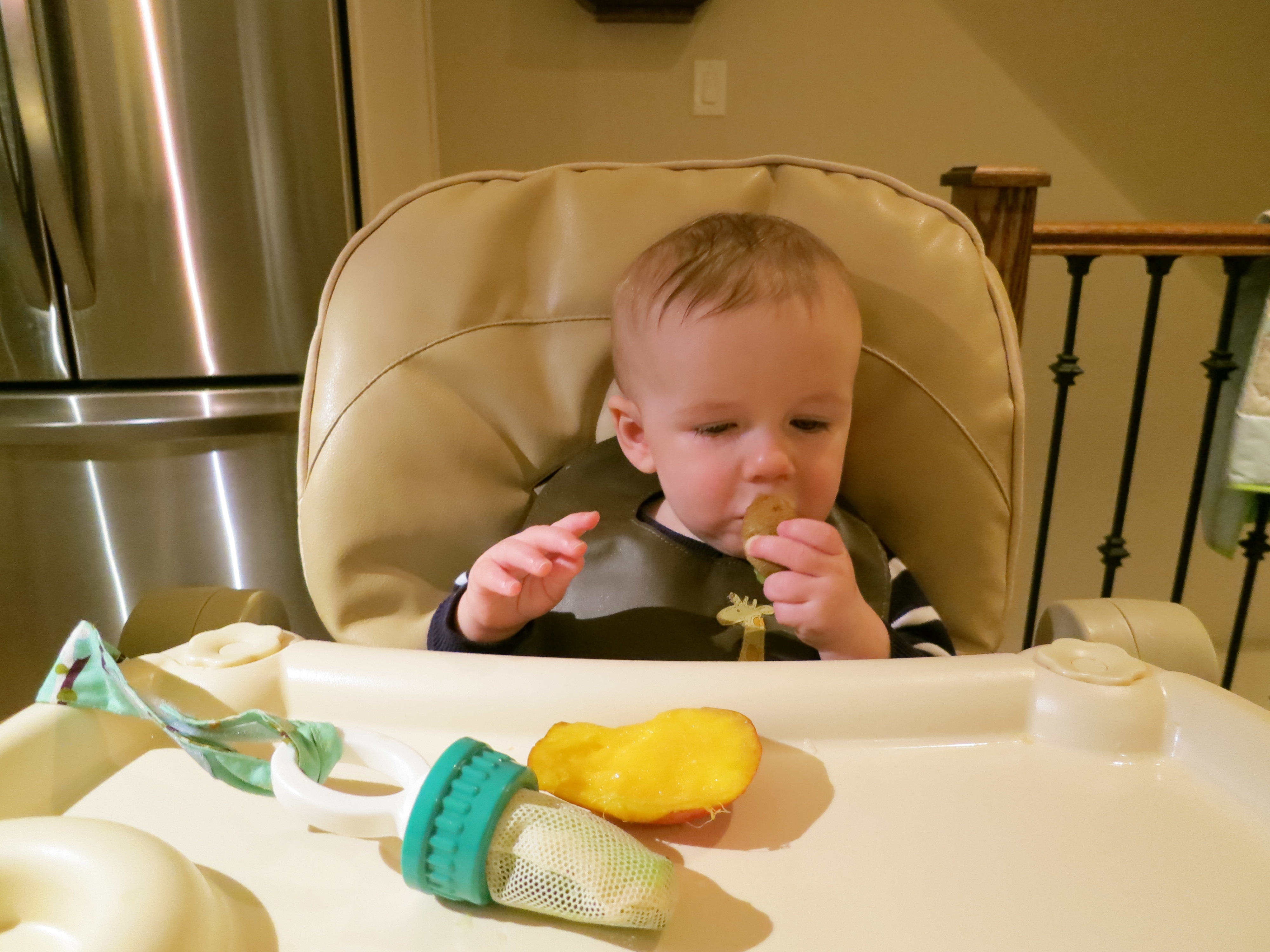
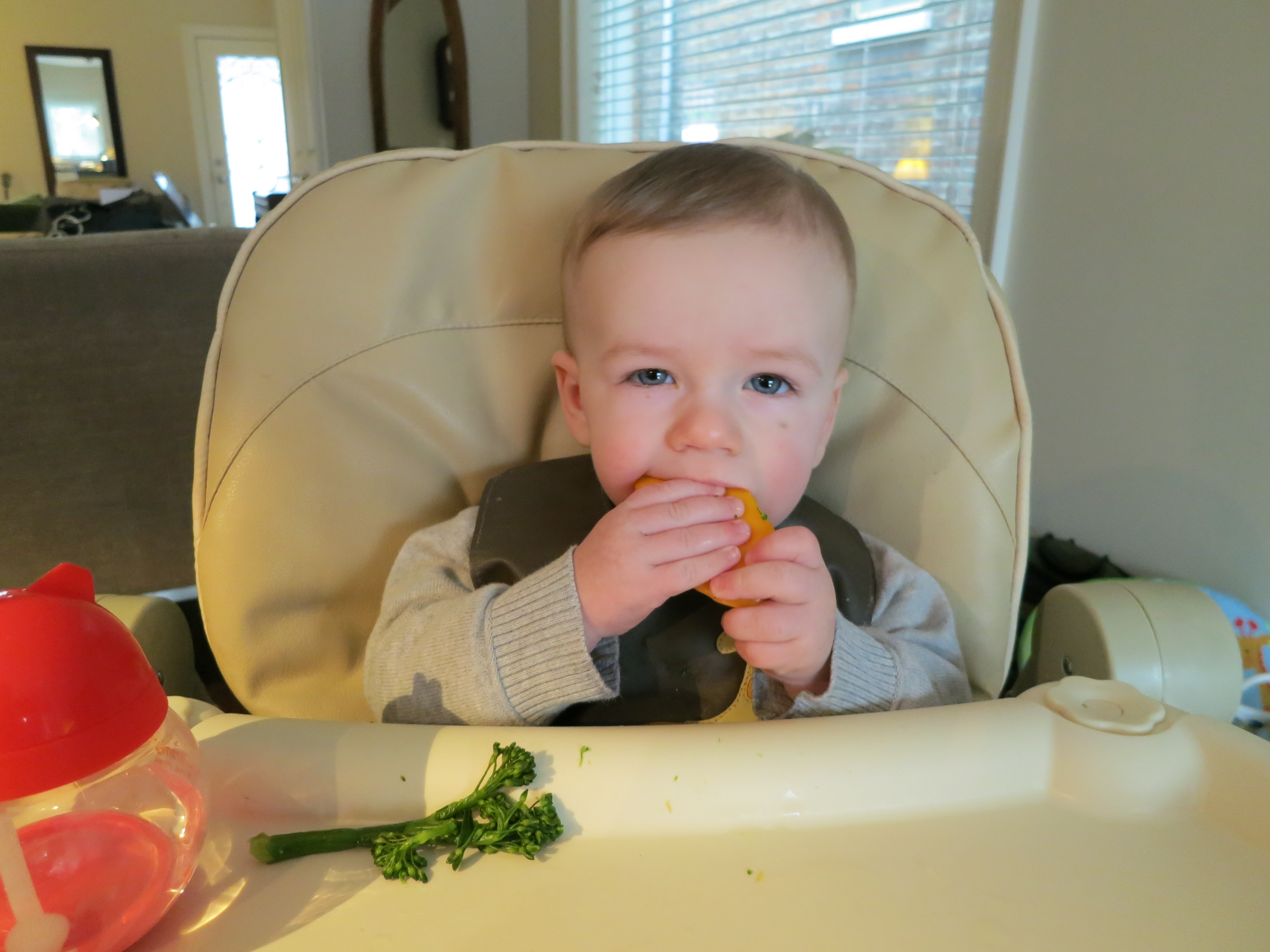
Mango and broccoli  – I served the mango like the papaya: sliced, with skin on for Gus, and skin off for the adults. For the broccoli, I made a stir fry with garlic slices and sesame oil for the adults, and steamed it in the microwave for Gus (as I wanted his broccoli to be softer than ours). This was a success all around.

Kiwi and green beans – For the kiwi, same treatment as the mango and papaya. The green beans were super easy. Our grocery store sells them in a plastic bag, with the ends already cut off. All you have to do is pierce the bag a few times, and steam the beans in the microwave for a few minutes. I then tossed our beans with some butter, and salt and pepper, and served them to Gus plain (and again, steamed a little longer than for the adults).

Tamarillo and butternut squash – Tama who? I discovered tamarillos in the exotic fruits section, after having already picked through the usual suspects of mango, papaya and kiwi. They look similar to roma tomatoes, though are more purpley/orange, and aren’t quite as soft. I figured I could serve them in wedges. After getting home, I did some research, and realized that tamarillos are not usually served raw since they are too bitter, but rather baked, steamed or poached in some fashion. I decided to bake them with sugar and vanilla, but was less than pleased with the result (I think I added too much vanilla extract), and in the end never ended up serving them to Gus. The butternut squash, however was a success! I found a recipe for a butternut squash and apple puree which sounded delicious. In addition to the squash and apple, it called for cumin, some vegetable stock, olive oil and salt and pepper. I did not add salt, and replaced the vegetable stock with extra olive oil (also to avoid salt) to make the dish more baby friendly, but even with these changes it was delicious!

This is a good opportunity for a sidebar about purees. While the divide between the traditional approach to introducing solids and BLW is often framed as pureed food vs. non-pureed food, there is certainly room for purees in BLW. One significant benefit of BLW is that it introduces babies to a variety of textures early on, and as one of the food websites that I follow pointed out, puree is also a texture. My rule is that if a dish would be served puree style to adults, it’s an option for us (with any baby friendly modifications required). So, this squash recipe, and my mother in law’s carrot turnip puree were perfect. Where I do have an issue with purees is with some of the commercial baby purees that throw together a strange combination of fruits and vegetables that we non-babies would never enjoy in combination.

As to serving the purees, I pre-load spoons for Gus, and as eats them, I load more on until he is done.

Cantaloupe and beets – Cantaloupe (see mango, papaya and kiwi above). I like beets, and they are actually a significant staple in my Eastern European heritage’s cuisine. But, I have always been scared of cooking with them myself, due to the mess, and also because they seemed so hard to get at. The recipe I chose was a beet salad with feta, dill, parsley and a dijon and red wine vinegar salad dressing. The beets were roasted in the oven first (skins on, tops chopped off, and wrapped in foil), and when they came out, the skins came off very easily. I made sure to wipe any beet juice quickly, and was happy to find that even though it was a very intense colour, it didn’t really stain quickly and was easy to clean off. My husband and I enjoyed the salad in its full glory, and Gus got beet wedges on their own.

Passionfruit and cauliflower – While I have tried many passionfruit flavoured foods, I have never tried passionfruit in its natural glory. Passionfruit is purple on the outside, and has an orangey pulp filled with small black seeds inside. The pulp is very sweet when the fruit is ripe, but the seeds are a bit bitter. After I sliced the passionfruit open, I hemmed and hawed about whether to give it to Gus, as I was worried about the seeds. I read some stuff online about serving passionfruit to babies, and even came across a recipe for passionfruit puree which called for pushing the passionfruit through a sieve to remove the seeds. I tried this, and managed to get a tiny bit of sweet pulp without any seeds to it. There was so little of it, and it was so slippery that I ended up serving it to Gus on my finger. Passionfruit gets wrinkled looking as it ripens, and is actually tastiest when it looks quite wrinkly and gross, and this morning I served Gus the pulp (including seeds) or our remaining wrinkly, sad looking passionfruit. This time, I pre loaded spoons for him, and while a lot of it slipped off, he quite enjoyed the bits that he managed to eat.

I have to admit that I am not a big fan of cauliflower, so I was looking for a different, innovative cauliflower recipe. While cauliflower with cheese sauce was tempting, I was hoping for something healthier, and came across for a recipe for cauliflower roasted with dijon mustard and garlic slices. The recipe also included small slices of bacon, but while that sounded delicious, I omitted it due to the salt content.  Overall, the recipe turned out well! It was still cauliflower, but definitely something I would try again.  I don’t think I ended up actually giving any of it to Gus though, as the cauliflower always seemed a bit too hard for my liking no matter how many times I microwaved it, and there were always lots of other foods around for him to try. I had previously served him some cauliflower and apple puree soup in a restaurant though, which made it easier to skip this time around.

With each “new” food that we’ve been buying, I have tried to introduce it (or a variation) again within a few weeks, so I get more comfortable with cooking with it and it does not fall off my radar. For squash, I have now also bought and cooked buttercup squash (wedges roasted with maple syrup and balsamic vinegar), and acorn squash (quarters roasted with butter and brown sugar), and this week I bought some yellow beets to try some of the other beet recipes I dug up on beet week. I have also bought broccolini a few times now, as a friendlier alternative to broccoli.

I meant to touch on other aspects of BLW in this post, but seeing as it’s so long already, I’ll save those thoughts for another day, and finish off with some pictures of Gus enjoying his food.

Gus enjoying some kiwi and mango (and cucumber in his mesh bag).

Gus enjoying some kiwi and mango (and cucumber in his mesh bag).

The mango shot!

The mango shot!

Baby Led Weaning – Week 1

As I mentioned in my last post, we took some baby steps with solids last month by sporadically introducing rice cereal when Gus was five months old. However, ever since I first learned about baby led weaning shortly after Gus was born, I decided that would be our primary method of introducing solids. For those who are unfamiliar with baby led weaning, the basic premise is that your baby feeds himself and eats what you do. That’s really all you need to know, but it is explained in more detail here: http://www.babyledweaning.com.

We are now six days into doing solids the BLW way, and so far I am a huge fan (and more importantly, so is Gus)! Since everyone has their own spin on how they proceed with BLW, I thought I would share what we’ve been doing so far, and what I plan to do in the future. As seems to be the case with most people who do BLW (as far as I can tell anyways, it is still pretty new to me), from time to time, I will stray from the pure BLW approach.

Variety of Foods Offered

I have been offering 2-3 different types of foods per sitting, which is working well. I have introduced a ton of different foods (which I will list below), but after the first few days, I am now trying to have at least one familiar food offered at each sitting.  I think for the time being we will stick with some trusty fruit basics at breakfast (apple, pear and banana are what we’ve done so far), and introduce new foods at lunch/dinner.

As part of the BLW exercise, I have a goal of introducing Gus to every fruit and vegetable in our grocery store over the next 6 to 12 months (I actually don’t know what a reasonable timeline is for such a goal…6 months seems ambitious, but 12 months seems generous).  This goal makes the weaning process even more fun and exciting, and will be good for the whole family, as I know that there are certain fruits/vegetables that I stay away from buying, either because I don’t like them (hello brussel sprouts! hello okra!) , am not comfortable cooking with them (hello squash!), or just plain don’t know what to do with (hello persimmons! ). For now, the plan is to buy at least one fruit and one vegetable on each shopping trip that is out of the ordinary for us, so I started a few days ago by buying papaya and eggplant.

My overall plan is to focus on fruits, vegetables, meats and fish initially and stay away from breads and pastas as long as possible, mostly because I think there’s less nutritional value in the breads and pastas and because I’m not worried about whether he will like them or not (what kid does not like pasta?).

Complexity of Foods Offered

I bought the Baby Led Weaning Cookbook as my primary BLW reference, and it includes some fantastic sounding recipes (green curry chicken anyone?) for meal times with baby. For now though, I am keeping things simple and primarily offering one ingredient foods (raw or steamed fruits/veggies) or very simple preparations (salmon with a mustard/ginger/brown sugar glaze).  I look at what we are eating and select foods/ingredients that meet this criteria, so while Gus is eating a version of what we are eating, strictly speaking it is not the same meal. I think we will probably continue on this path for another week, maybe two before offering more complex meals.

Variations on a Theme

I am doing a few things which are not part of the BLW approach. The biggest deviation so far has been the baby cereal, which I started last month before Gus was old enough to try BLW. I started with rice cereal, and have now also done oat cereal. The plan for now is to give him one serving of baby cereal a day to ensure that his iron needs are met. Now, like everything else, there are several schools of thought on how necessary this actually is, however I feel like I am able to “check a box” by doing this and worry less about the risk that by doing BLW I am not meeting his nutritional needs.

I have also been using a little mesh feeder for certain foods (it’s a mesh bag that you put the food in, and then screw into a plastic top which has a handle baby can hold). It is a nice alternative for foods like apples which are hard and potential choking hazards, and as a bonus I can tether it to his high chair so when he throws it around, it does not end up on the floor like the other food. Since part of the BLW philosophy is that it gets babies used to different textures, mushing food through mesh does not accomplish this goal, but I have found this variation to be very helpful.

Lastly, I am planning to offer Gus soup in his bottle from time to time, since I have some soups that I think he would enjoy fairly early on.

Foods Introduced So Far

Gus has enjoyed the following foods to date:

Fruits – apple (in mesh bag), pear (in mesh bag and alone), banana (served as 1/3 of banana, nibbled like a cob of corn), stewed apricot, nectarine (cut in a wedge).

Vegetables – turnips (steamed and mashed with carrots – surprisingly like baby food, but actually part of my mother in law’s Christmas dinner), carrots (see turnips), asparagus (steamed way softer than I would normally do for ourselves and served in an individual stalk), basil (one giant leaf), beets (borsch soup in a bottle – I think this one upset his tummy a bit).

Meats – pork (marinated in Italian salad dressing and roasted on the bbq), turkey breast (part of Christmas dinner), salmon (broiled, with a brown sugar, mustard and ginger glaze).

Other – buffalo mozzarella (a big slice).

So far, everything has been a hit. He mostly sucks on things, but from time to time I will see him take little nibbles of stuff, so he is actually eating a tiny bit here and there. It’s been super fun watching him explore and shove food into his mouth, though it is also nerve wracking as I am constantly watching to make sure he hasn’t bit off a huge piece that he can choke on.

That’s the scoop for now. I had other thoughts I wanted to share, but since this post is sufficiently long as is, I’ll save them for a future BLW post.

Recent Milestones

It has been ages since I last wrote, but the blog is not forgotten! I have posts on several topics that are itching to be written, however it has been hard to find the time to sit down and write them. The main reason for this is that I have started working again as of the middle of November (this topic deserves about 10 posts in itself). At this point, my workload is light and manageable – ten hours a week from home, which I can work any time of day.  I try to work as much as possible in the evenings after Gus has gone to bed, or on Sundays when my husband takes care of him for a few hours at a time, which takes away from my blogging time.

Gus is six months old tomorrow, and as expected since I last wrote, he’s grown and changed a lot:

Teeth – Gus has his two bottom teeth which suddenly appeared about a week before he turned 5 months. We  are expecting more to come in shortly as lately he has been pretty fussy and obviously bothered by painful gums.

Sitting – Gus finally started sitting earlier this week. I say finally because even though he started sitting right around  6 months, which is textbook, I had felt like he was sooo close for the last month. I kept trying with him, but he could only manage one or two seconds here and there until we finally had a breakthrough. We even managed to get some great video of the early sitting days.

Solids – I was originally planning on waiting until 6 months to start solids, since I am planning to do baby led weaning. however I caved and gave Gus some rice cereal this past month, since I couldn’t wait to start.  This is a topic that deserves a post all of its own, which hopefully I’ll get to eventually. In the meantime, Gus has loved the cereal and I’m excited to start the real stuff this weekend now that he’s 6 months old.

Mobility – While crawling is still a few months away (I’m assuming), Gus is getting stronger and stronger and has some rudimentary moves. I don’t know the official name for what he’s doing, but he plants his head on the ground, sticks his butt up in the air and propels himself forward with his legs. He’s not doing it a lot yet, but it’s very effective when a toy that he’s interested in is just out of reach.

I was planning on writing about our recently completed first family vacation in this post, however Gus is ready for a feeding so instead I’ll finish off with one more picture from vacation.

Gus in our new baby carrier.

Gus in our new baby carrier.

Taking Baby(wearing) Steps

Like any North American baby born to financially comfortable parents these days, Gus comes with a lot of gear. In the second and third trimester, I did my research and over time we bought the chosen items so that by the time he was born, we had everything we wanted. Both my husband and I try to avoid clutter as much as possible, and while our house is not small, it’s not big either. So, I tried not to buy multiple things that served the same purpose, figuring that once the baby was here, if we felt like what we had was lacking, we could always buy something then. Over the last four months, we have steadily used all of the items bought, and have overwhelmingly been pleased with each purchase.

One thing that did take some time to catch on with me was our baby carrier.  We bought the Ergo baby carrier, along with the infant insert, so that we wouldn’t need a second carrier for when Gus was a newborn.  Many people I know like slings in the beginning, but the concept of a sling scared me. I remember reading a story several years ago  on CNN (I think before we even started trying for a baby) about a woman whose baby suffocated in her sling when it was only a few weeks old, and I have never been able to forget the pictures accompanying the story showing the woman smiling with her baby in the hospital bed shortly after giving birth, combined with the thought of how horrible it must have been to lose the baby so soon afterwards.  I have since read of several sling styles that were recalled, and how you need to make sure your baby is positioned a certain way so that their airway stays open, but even though I know that in the vast, vast majority of cases slings are now safe I felt like I would be on constant high alert if I used one.

Based on everything I’d read, I was very excited about the Ergo carrier, and about babywearing in general. I expected to use it all the time once Gus was born, however a few things happened that dampened my initial excitement. The first thing took place in our baby care class at the end of May where the instructor had the men model different types of carriers, and then we talked about the pros/cons of each carrier. As she wisely pointed out when we got to the Ergo carrier, the infant insert (which is essentially a quilt) tucked into the carrier would make for a hot baby, and therefore this combination was not that practical for the hot summer months.  This made perfect sense to me, so once Gus was born, using the carrier was not top of mind.

When Gus was about a month old, I finally pulled out the carrier and the insert as I felt that we should try it out sooner rather than later. I tried the insert and carrier on myself, but it didn’t feel quite right. I was recovering from a c section, and while I generally felt fine, I was wary of my doctor’s instructions that I should not carry anything heavier than the baby for 6 weeks. While the carrier itself was not very heavy, something about having Gus pressed against my stomach for a longer stretch of time made me uncomfortable, so I decided to wait a few more weeks before trying it again. In the meantime, my husband also tried the carrier, and took to it quite well, so from time to time when we went out for a walk, he would use the carrier instead of our stroller.

I was happy that the carrier was finally in circulation and that it had also turned out to be a successful purchase. I tried it again a few weeks later when we went for a walk, but again I didn’t really like using it. I felt uncomfortable with the fact that I couldn’t see my feet, and was worried that Gus would fall out (or that the infant insert wasn’t positioned properly). So, I once again left the babywearing to my husband.

In September, I started baby and me fitness with Gus. The community centre where the classes are held has a few stairs when you first go inside, and there is a tiny elevator that will take you up to the front desk if you are not able to use the stairs. After a few classes, I became aware of the contrast between the moms who brought strollers and had to line up at the elevator after class, versus the moms who just strapped their babies on and went merrily on their way. One way looked way simpler than the other way, and I was jealous at the ease with which the babywearing moms moved around.

However, I continued to use the stroller, even after the elevator started acting up, and security guards had to be posted next to the elevator to instruct people on how exactly to stand in the elevator so it would work properly (or in the worst case scenario, carry strollers up the stairs). Even with the added hassle of not knowing if the elevator was gong to work though, I still stayed away from the baby carrier.

And then last week, I caved and joined the dark side! After weeks of scheduling madness, my friend and I had finally managed to arrange a lunch date next to her office. My original plan was to drive, however as I thought of the bother of parking on a busy downtown street, I decided that walking the stroller down would be a better option (especially once the forecast called for an unseasonably warm, sunny October day).

On the day of our lunch date, I got Gus all ready to go, and went to grab the key that we use to lock our stroller to the front porch, only to find that it was not in its usual spot in our piano bench. I looked closer, and it still wasn’t there. I checked if I’d left it in the lock, or inadvertently tucked it into a pocket or my purse. Nothing. I checked the bench again, taking everything out of it (not once, but twice), and checking the bottom of the bench carefully in case the key had slipped in between the cracks in the wood. Still nothing. I took everything out of my purse. No key.

I finally decided that it was best to go back to plan A, and drive down. Since I couldn’t take the stroller with me to the restaurant, once I parked, I would carry Gus in the Ergo. We had recently stopped using the infant insert, and when I tucked Gus into the carrier, babywearing felt a lot more natural than it had with the insert. I walked out to the car with him, only to find that the car wouldn’t start!

I had been looking forward to lunch with my friend all week and was determined to make it happen. With the stroller and the car both out of commission, I decided the only option left was to strap Gus on and take the streetcar down to my destination. So, off we went! Gus enjoyed his first streetcar ride, and I relished the flexibility that being able to easily take Gus on public transportation offered us. Lunch was great, and on the way back, I enjoyed an hour walk back, with a sleeping Gus snuggled up against me.

Ever since our first successful outing, I have taken Gus out in the carrier several times, happy to finally join the ranks of the baby wearing mamas.

Baby Boy’s First Halloween

Baby Boy in his tiger costume. This is from a professional shoot we did a few weeks before Halloween.

For as long as my husband and I have lived together, we have always gotten into the spirit of Halloween, and over the years we have built up some special traditions.

In our old house, we had a basement suite that we rented to tenants. The first year in that house, my husband came up with the idea to invite our tenants up to our place to hand out candy with us, since the trick or treaters weren’t likely to find the tenants’ “front” door, which was at the back of our house. This was also a nice excuse for us to socialize with our tenants without the risk of muddying the landlord tenant relationship.  And thus, a Halloween tradition was born!

We would order pizza, drink beer, and take turns handing candy out to the kids coming to our door. To keep things interesting, we would also take bets at the beginning of the night as to what the most popular costumes would be (keeping in mind any recent blockbuster movies or current events), and then track the number of kids we got, along with what costume each one wore.

Pumpkin carving was another tradition. Rather than sticking with the usual scary face, our pumpkin would typically be carved with a scary sign of the times.  Over the years, we have had a pumpkin carved with the initials of a proposed new tax, a symbol of a controversial government program, and (our favourite) – the “economic downturn” pumpkin of 2008.

A few years ago, we even started dressing our cat up in a pumpkin costume. While the costume suited his round proportions very well, he never seemed very happy in it! The costume was actually made for small dogs (and therefore didn’t fit him well in all the right places), and after seeing the resigned expression on his face when we subjected him to another year of dressing up, I understand why we were not able to find a costume made especially for cats.

Last summer we moved back to Toronto after an eight year absence, which meant we were once again living close to both our families. My mom and cousins had been getting together at my mom’s place the last few years, as the houses in her neighbourhood tended to go over the top with decorations, so now that we were back, we were invited to join them. While we no longer had tenants to invite upstairs, my husband and I were really looking forward to enjoying our first Halloween in our new house, so in the end we moved the party to our house hosting my mom and stepfather, as well as my cousin, his wife and two little kids. Everyone had a blast, and we were hiding a little secret that I was eight weeks pregnant. I remember saying to my husband at the time “Can you believe that next year we will get to dress embie up in a costume??”.

This year was mostly a repeat of last year (I think the new tradition is that everyone comes to our house for Halloween!), with the important difference that Baby Boy was on the scene now. I bought him a tiger costume, and my husband and I couldn’t resist taking him out to see a few of our neighbours. Even though Baby Boy is too little to enjoy candy, our neighbours insisted we fill up for ourselves (an unexpected bonus), and despite the dreary, rainy weather, we had so much fun showing off our little Tiger!  I can’t wait to share Halloween memories with our boy in the years to come.

Here are a few Halloween night pictures:

Baby Boy filling up before getting in costume.

Baby Boy in full tiger glory (I love the tail!)

Breastyelling and Other Adventures – Part 2

This post is a continuation of my earlier post about the various trials and tribulations I’ve experienced while breastfeeding. Since I had so much to write, I thought it would be best to  write several posts instead of one giant one.

In Part 1, I talked about latching, long feeds, and painful feedings. Part 2 continues with further adventures….

Mastitis

Just when I felt like I was getting comfortable with breastfeeding, one afternoon when Baby Boy was about a month old, my left breast suddenly started to hurt a lot. This was accompanied by fever and chills and a general flu like feeling, as well as some redness on the side of my breast. I went to see my doctor the next day who confirmed that I had mastitis, and prescribed antibiotics for ten days. The antibiotics worked quickly, and the fever and pain subsided the next day, though I felt quite weak and tired for a few days.

Mastitis: the Sequel

About a week after I finished the antibiotics, I woke up one morning, and my left breast felt like it was on fire. I couldn’t concentrate on anything but the pain, and the entire bottom half of my breast was bright red as if I had a sunburn. Since it was a Saturday, I went to a walk-in clinic, and got prescribed another round of antibiotics. Once again, the antibiotics seemed to work quickly. On Sunday, I felt much better, however Monday night, my right breast got sore, and the fever was back.

While before, my fever had quickly subsided with tylenol, this time, even after taking 2 extra strength tylenols, my fever kept rising over the course of several hours from 38.5C (101.3F) all the way to 39.7C (103.5F). It finally broke, which was a huge relief. It came back briefly the next day, but never got as high, and responded well to the tylenol. While I really should have gone back to the doctor at this point, we were heading up to my inlaws’ cottage Wednesday morning, and I couldn’t get an appointment with my doctor before we left, so I decided that things looked to be under control, and carried on.

A few days later, my left breast was again quite sore one evening, but I didn’t have a fever, and after a few hours, the pain passed. Then, when I was almost done the ten day round of antibiotics, I started to feel feverish and searing pain returned to my breast. I went to see the urgent care doctor that evening. He was quite concerned that the fever and infection were back despite the antibiotics, and he prescribed a strong dose of another antibiotic, indicating that if this one did not work within a few days then the next step would be IV antibiotics at the hospital (yikes!).

Thankfully the antibiotic was effective and I started to feel better. The antibiotic itself was quite rough on my system though, and I had noticeable stomach irritation, as well as bad heartburn. After about 8 days, I developed a rash which started on my forearms, then quickly spread to my legs and the rest of my body. It started out as small red bumps, turning to big red blotches (especially where my skin rubbed against itself). It was a little itchy, but more than that it burned. I went back to my doctor who confirmed my suspicions that I was having an allergic reaction to the antibiotic. After a few days of taking over the counter allergy medication and spreading calamine lotion all over myself, with little to no change in the rash, I moved to Plan B and took the steroid that my Dr. had prescribed, which finally got the rash to subside.

Hopefully that is the last I see of mastitis, not the least because I don’t know what my treatment options would be next time around.

Supply (and Demand)

Throughout the ups and downs, I have comforted myself with the thought that unlike many people I know I am lucky to have enough supply. However around the time of the mastitis saga, even my normally dependable supply let me down, resulting in a significant level of formula supplementation for the first time (upto that time, I had only done one formula feeding on the day after my milk first came in). After a few days,  my supply went back to normal and I went back to exclusively breastfeeding/pumping for Baby Boy’s dietary needs.

Baby Boy and I then enjoyed a golden month of breastfeeding. Things were not perfect: I was still feeding him primarily on the right side; and my few halfhearted attempts at figuring out how to position him for feeding in public were epic fails (I finally decided that until he’s at a point where he can be satisfied with shorter feeds, being able to feed in public is not a priority for me). Since my supply was back up, I did not have to worry about supplementing with formula, and I often had a bottle or two for future feeds ready to go in the fridge.

I should mention here that Baby Boy is a good eater. From about 1.5 to 2.5 months, Baby Boy would consume 150ml (5oz)  at a time during his bottle feeds. By this time, I had determined that 20 minutes was the optimal pumping time for me, resulting in a typical yield of 150ml to 220ml (7.4oz). At 2.5 months we noticed that often Baby Boy was still drinking pretty hard at the end of the bottle, and the odd time that we gave him a bit extra he took it no problem. So we increased his bottle feeds to 180ml (6oz) to 200ml (6.8oz) at a time. The increased demand put some pressure on me, but for the most part I was still able to pump enough for his bottle feeds.

Then, in the first week of October when Baby Boy was 3.5 months old, the pumping suddenly went to hell. After several days of record yields (3 days in a row where I had a pumping session that yielded over 300ml or 10.1oz), I was suddenly unable to get more than 100ml (3.4oz). On the day after I had a pump session that yielded 330ml (11.2oz) – a record for me – I had a pump that yielded only 40ml (1.4oz).  I then had a stretch of about five and half days where most sessions yielded between 70ml (2.4oz) and 90ml (3oz) and I barely got anything above 100ml.

I found this turn of events really distressing because I had no idea what caused it. I was pumping with the same frequency as before, and I could not identify anything that had changed in my routine. I started to wonder if maybe my pump had lost some of its suction, so I did all of the maintenance and cleaning that was recommended, with no discernible result. Since I could not pump enough at a time for even half a bottle, we ended up using a lot of formula to make up the difference. I continued to breastfeed, hoping that Baby Boy could get enough milk on his own, but worrying that this was not the case.

I finally decided to rent a pump from the hospital (which I had originally done when Baby Boy was first born) to see if I could get more milk than from my pump, but right before I was to call to rent the pump, I suddenly had a pump session that yielded 240ml (8oz). And just like that, I was back to yields of 150ml to 220ml.

I’m now back to good pumping yields and relatively hassle free feeding. I’m hoping that (once again!) the worst is behind me and that the breastfeeding experience will be overwhelmingly positive from here on in. I do have more to say on the topic of breastfeeding, and now that I have summarized what my experience has been to date, I will finally write the breastfeeding post that I originally intended to write. Stay tuned!